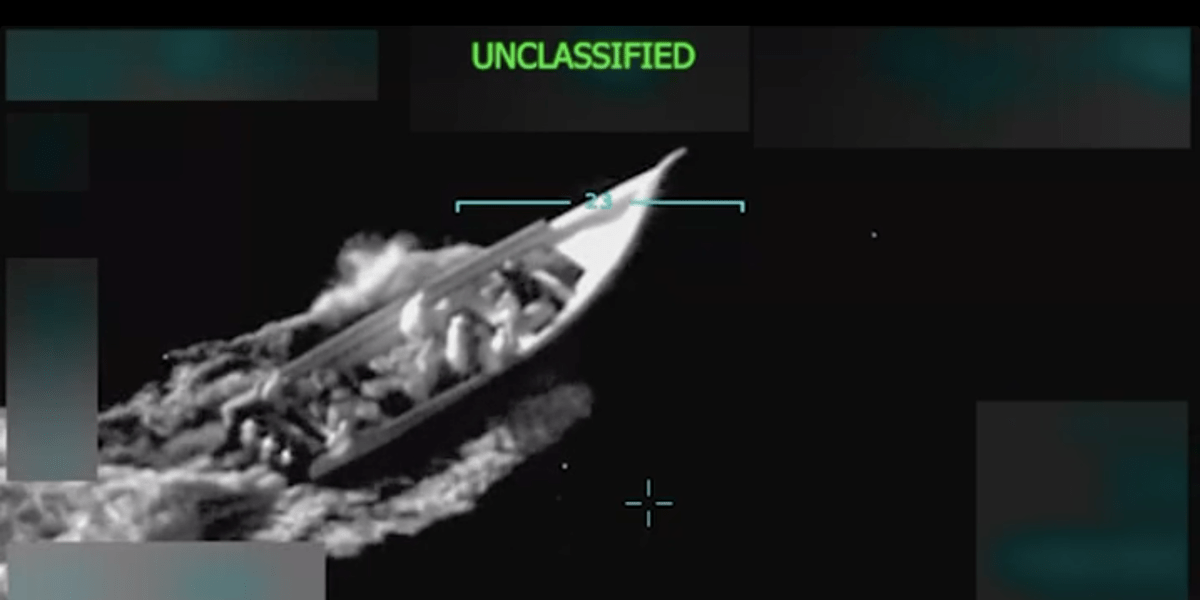
Over the last two months, the US has carried out 15 known military strikes on boats in international waters. The strikes occurred in both the Pacific Ocean and the Caribbean Sea. The strikes reportedly killed more than 60 individuals aboard the boats. The Administration claims these were all “narco-trafficking vessels” or “drug boats.” They claim the boats were carrying illegal drugs from Venezuela and Columbia bound for the US. The Administration labels those aboard the boats as “narco-terrorists” belonging to drug gangs and drug cartels designated as “terrorist organizations.”
On the surface, preventing illicit drugs from entering our country seems like a good idea. And combating drug gangs and drug cartels also seems like a good idea. But blowing up boats in the middle of the ocean sounds extreme. If you watch the footage of these drone strikes, it is jarring. Is the Administration doing the right and lawful thing here? The legal justification is murky at best.
The Administration Is Trying to Change the Paradigm
In the US, we traditionally view drug trafficking as a crime and its perpetrators as criminals. We rely on the DEA, the FBI, the DOJ and other law enforcement agencies to investigate and prosecute drug traffickers. We expect them to abide by certain constitutional and legal norms like search warrants, due process, presumption of innocence, jury trials and sentencing guidelines. Prosectors, defense attorneys, judges and juries all serve a crucial role in determining guilt and pronouncing sentences for drug traffickers. Our criminal justice system does not permit one person to serve as judge, jury and executioner. Importantly, drug trafficking generally is not considered a capital offense that could subject an offender to the death penalty.
The US also has bilateral agreements with many countries to assist in law enforcement against drug trafficking. The US Coast Guard interdicts suspected drug smuggling vessels, sometimes with assistance from other countries. There are established legal processes for intercepting suspected drug smuggling vessels and then prosecuting offenders.
The Administration is trying to change this paradigm. The Administration wants us to view foreign drug traffickers through the lens of warfare, rather than criminality. According to the Administration, foreign drug traffickers are “terrorists” to be treated no differently than members of Al-Qaeda. Through this rhetorical shift, the Administration is exercising broad wartime powers and treating foreign drug traffickers as enemy combatants. They subject these foreign drug traffickers to the swift, summary justice of warfare.
The paradigmatic shift matters. A core principle of our criminal justice system is that it is better to set nine guilty men free than it is to imprison one innocent man. This principle is not up for debate. It is embedded in the “beyond a reasonable doubt” standard of proof. The warfare calculus is different. Collateral damage like killing innocent civilians is a tragic but almost unavoidable consequence of sustained military engagements. See the war in Gaza, or the war in Ukraine, or the civil war in Sudan, or the civil war in Myanmar. The difference between the law enforcement paradigm and the warfare paradigm is significant.
The Administration Is Designating Foreign Gangs and Drug Cartels As “Terrorists”
Congress has given the Secretary of State authority to designate “foreign terrorist organizations.” There are three criteria for being so designated: 1) a foreign organization 2) engaged in terrorist activity that 3) threatens our national security. The definition of “terrorist activity” is quite broad. It is not hard to construe foreign gangs and drug cartels as engaging in “terrorist activity.”
The Secretary of State’s authority is subject to typical checks and balances. The Secretary of State must notify congressional leaders of new designations. Congress has the authority to pass a law blocking or revoking any such designation. There is a procedure for appealing to the Secretary of State to change designations. There also is a procedure to challenge designations in court.
Since February 2025, the Secretary of State has added 19 organizations to the list of Designated Foreign Terrorist Organizations. A large number of those are gangs, such as MS-13 and Tren de Aragua, and drug cartels, such as Carteles Unidos and Cartel del Golfo. There does not appear to be any serious debate over whether these groups ought to be designated as foreign terrorists.
We Don’t Care Much About Suspected Terrorists
Once designated as a foreign terrorist, the Secretary of Treasury may require US financial institutions to freeze assets of the organization. Those assets remain frozen until ordered otherwise by the Secretary of Treasury, an Act of Congress, or a Court. This is a powerful tool.
There is nothing in the law that gives the President explicit authority to order military strikes on designated foreign terrorist organizations. Even after 9/11, President Bush sought congressional approval to prosecute the war on Al-Qaeda, to deploy troops to Afghanistan, and to deploy troops to Iraq. The US also appealed to the international community before and during those deployments. The current President did not do any of those things here before ordering military strikes on alleged drug traffickers.
Designating foreign gangs and drug cartels as “terrorists” certainly helps the Administration in the court of public opinion. Once someone or something is labeled a “terrorist”, many of us just don’t care as much about their rights or even their lives. Many of us view terrorists as less than human. We need to get them before they get us. This is particularly true for those of us who lived through 9/11. But they are human. And we are supposedly the torchbearers of liberty and democracy. Labeling someone as a terrorist alone does not justify the use of deadly military force.
Congress Is Missing in Action Yet Again
Regardless of how we feel about terrorists, allowing the President to order military strikes without the requisite legal authority is a slippery slope. Previously on this blog, I wrote about the President’s authority to order strikes on Iranian nuclear facilities. War! What Is It Good For? – Welcome to Seabolt’s Public Square. I explained how the War Powers Resolution Act authorized the President to deploy the military for discrete missions. This authority is limited to a 60-day period and is subject to oversight by Congress.
The Administration claims its military strikes on drug traffickers are not subject to the War Powers Resolution Act. They think they can order these military strikes without any oversight by Congress. The Administration claims it received a “legal opinion” confirming its position. However, the Administration refuses to release the legal opinion claiming it is classified. To be clear, the legal authority supporting the Administration’s position – if there is any – is not classified. While the legal opinion might contain classified information, the Administration can redact that information and still disclose the legal authority. The Administration’s lack of transparency is concerning.
Without disclosing the legal opinion, it is unclear what authority the President was exercising when he ordered these military strikes. The US Presidency is a position of limited authority. That is, every official act undertaken by the President requires a grant of authority under the Constitution or an act of Congress. Without such a grant of authority, the President is acting illegally. Moreover, the Constitution does not permit the President to deploy our military without congressional oversight. Congress has a constitutional imperative to oversee the President’s deployment of military assets. Congress must do more here.
There Are Rumblings in the International Community
There is increasing opposition to these military strikes in the international community. The Venezuelan government has responded by mobilizing its military. United Nations officials have condemned the strikes as human rights violations and extra judicial killings. These rumblings should concern us.
The US Supreme Court granted the President immunity from prosecution for acts committed in his official capacity. However, this immunity only applies in domestic courts. It does not apply, for example, in the International Criminal Court. Numerous world leaders have been indicted in the International Criminal Court for crimes against humanity, war crimes, and the like. See recent examples of Vladimir Putin (Russia), Benjamin Netanyahu (Israel), Rodrigo Duterte (Philippines), Omal al-Bashir (Sudan).
Some might think the international community would not dare bring criminal charges against a sitting US President. That certainly would have been the conventional wisdom before this Administration. This President, however, has bucked convention, particularly on the international stage. The President has spent much of his second term sticking his thumb in the eye of the international community. His form of foreign diplomacy is not diplomacy at all. The President derides foreign leaders, he ignites trade wars, he withholds foreign aid, and he threatens nuclear weapons testing. Now the President is deploying military assets arguably in violation of international law. Despite the restraint world leaders might show publicly, there are many who would like to see this President knocked down a peg or three. There are others who fear where this is all going. One might argue that a sitting US President has never been more politically vulnerable on the international stage.
If our feckless Congress continues to sit this one out, we can expect to hear more and more outrage and objection from the international community. This is particularly so if the President continues to order more military strikes. Those words will eventually evolve into action. Congress should handle this business in-house before others try to handle it for us.
Comments
66 responses to “This Is Not A Video Game”
https://shorturl.fm/4h47v
https://shorturl.fm/G1wwj
https://shorturl.fm/e3L96
https://shorturl.fm/EjaI1
https://shorturl.fm/zH9OI
https://shorturl.fm/NJCqd
https://shorturl.fm/QA9N3
https://shorturl.fm/0vadc
https://shorturl.fm/oBBjr
https://shorturl.fm/Z9NVI
https://shorturl.fm/PcooI
https://shorturl.fm/f1dLG
https://shorturl.fm/Y6fMi
https://shorturl.fm/TKYB6
https://shorturl.fm/hFkYe
https://shorturl.fm/n6STF
https://shorturl.fm/83GF4
https://shorturl.fm/teova
https://shorturl.fm/BOfof
https://shorturl.fm/hlWYO
https://shorturl.fm/vusXp
https://shorturl.fm/wZINY
https://shorturl.fm/rCh5m
https://shorturl.fm/y1Nch
https://shorturl.fm/WhdjD
https://shorturl.fm/XVTNA
https://shorturl.fm/BQvLA
https://shorturl.fm/axGQS
https://shorturl.fm/gQOCW
https://shorturl.fm/DmSPQ
https://shorturl.fm/uUMaZ
https://shorturl.fm/oWKHa
https://shorturl.fm/RVCpx
https://shorturl.fm/vAu5l
https://shorturl.fm/znLn7
https://shorturl.fm/lU5Qi
https://shorturl.fm/ulBSl
https://shorturl.fm/IdzRL
https://shorturl.fm/fFDTJ
https://shorturl.fm/T6BBQ
https://shorturl.fm/WBGcn
https://shorturl.fm/UrXdk
https://shorturl.fm/bEVs2
https://shorturl.fm/sKZ55
https://shorturl.fm/Nn1w6
https://shorturl.fm/puxfL
https://shorturl.fm/xMPKw
https://shorturl.fm/WzWuK
https://shorturl.fm/JxYgZ
https://shorturl.fm/CxVwL
https://shorturl.fm/v8Bgz
https://shorturl.fm/DWcWX
https://shorturl.fm/xobB9
https://shorturl.fm/yJ137
https://shorturl.fm/yi2S3
https://shorturl.fm/Z4lvV
https://shorturl.fm/at2Py
https://shorturl.fm/usGYO
https://shorturl.fm/kmwYn
https://shorturl.fm/7N4So
https://shorturl.fm/jvw17
https://shorturl.fm/FFAlJ
https://shorturl.fm/bN5jW
https://shorturl.fm/ym4PB
https://shorturl.fm/k40Bi
https://shorturl.fm/N3EJc