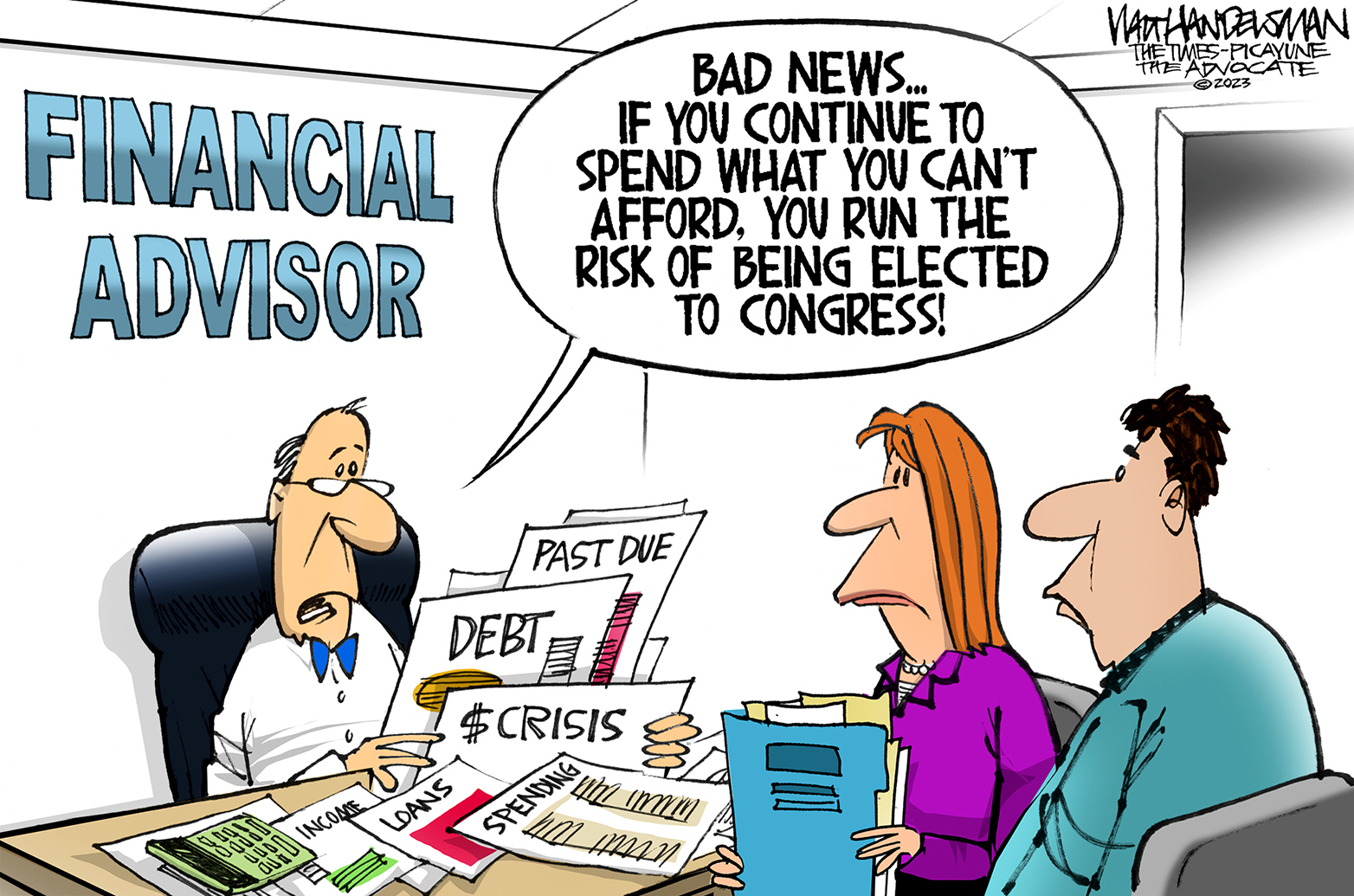
Budget discussions continue to dominate Washington, D.C. Senators are pushing back on the Big, Beautiful Bill and making noise about requiring real progress on the deficit. It remains to be seen whether these Senators will take a principled stance. I am not holding my breath.
In an earlier post, we discussed our government’s addiction to debt. I thought we might pause here to consider that addiction more closely.
We Are On An Unsustainable Path
Recall that our national debt stands at about $36.6 trillion. In 2024, our gross domestic product (GDP) was about $29.1 trillion. This is a proxy for the size of our economy. So our national debt is 26% bigger than our entire economy. This is bad. For reference, when the Greek economy collapsed in 2009, its debt to GDP ratio was 115%. The EU’s debt to GDP ratio is approximately 81%. Again, the U.S. stands at 126%.
Our GDP grows at a rate of about 2.5-3% per year. In recent history, our deficit spending has averaged about 6-6.5% of GDP per year. This means that our national debt is growing faster than our economy, so the gap continues to widen. This is not just bad. It is unsustainable. As another point of reference, the EU expects its members to keep deficit spending below 3% of GDP.
Congress Cannot Balance A Household Budget
To put this into context, imagine a household earning $100,000 per year. That same household spends 106% of what they earn every year, so they assume $6,000 in credit card debt. The next year, the household receives a 3% raise, so it now earns $103,000. But it continues to spend 106% of what it earns, accumulating another $6,000 in credit card debt. After the second year, it now has a total of $12,000 in credit card debt.
This pattern continues for 35 years. At the end of 35 years, the household earns a healthy $200,000 per year. But they continue to spend 106% of what they earn, which is now $12,000 in credit card debt per year. Over the years, they have accumulated about $250,000 in total credit card debt. And they don’t have any assets or any savings because they outspent their income all along.
The Numbers Are Bigger, But The Math Is The Same
This is essentially what our federal government has done. The income represents our GDP, and the accumulated credit card debt represents our national debt. When the government raises the debt ceiling, they have maxed our their credit card and they want to open a new one. Except they never pay off the old one. They just roll it over and continue to spend more than we earn. So we can never make up any ground.
As should be obvious, this is unsustainable. The U.S. will eventually have to live within its means. We can do it voluntarily or it can be forced upon us. We should choose to do it voluntarily. The involuntary path is quite messy and onerous. See Greece in 2009.
Creditors Will Eventually Say Enough Is Enough
Speaking of reckonings, let’s consider U.S. treasury bonds. Treasury bonds are the vehicle through which the government borrows money to pay for deficit spending. It is the government’s credit card in the analogy above. When interest rates on ten- and thirty-year treasury bonds rise, that means two important and related things have happened. First, the market has lost confidence in the U.S.’s ability to service its debt. Second, the market has decided to charge the U.S. a higher interest rate going forward to account for the additional risk. When people talk about bond markets sending negative signals or getting wobbly, this is what they mean.
There is an inflection point out there when bond holders will say enough is enough. The market will eventually clap back. No one knows exactly where the inflection point is. But when we hit it, trouble will follow fast and furious. In my opinion, we entered dangerous territory when our debt eclipsed our GDP, which happened around 2012. Since then, every time our government raises the debt ceiling, it is rolling the dice. Every time our government adopts deficit spending greater than 3% of GDP, it is rolling the dice.
We Need Serious Policy
To maintain trust with the markets long term, I think our government needs to adopt some policies. Put a cap on the debt. Put a cap on deficit spending. Do the hard work of balancing the budget now and stop kicking the can down the road. Provide a real plan for reducing the debt starting now, not in five or ten years. Continuing to raise the debt ceiling and to spend more than we earn without any discernible policy is beyond irresponsible. It is a game of craps. And the house always wins.